
This article initially appeared in Shore Local News on Jan. 15, 2026
The Jersey Shore had two memorable tidal flooding events in 2025 – August’s Hurricane Erin, and an October nor’easter. New analysis shows that while tidal flooding in 2025 was generally lower than in 2023 and 2024, most of the South Jersey shoreline still flooded more than it had in decades past.
A plethora of smaller storm systems and astronomical high tide cycles also brought minor, or nuisance flooding. Despite the intensity of the flooding, the amount of coastal flooding events in 2025 saw a split, familiar to many, between North and South Jersey (I will not get into the merits of Central Jersey in this column).
National Oceanic and Atmospheric Administration tide gauges from Ship Bottom down to Cape May, and out to the Delaware Bay show the number of 2025 coastal flooding events was above the period of record average, according to PJ Hondros of Stockton University’s Coastal Research Center in Port Republic. Here are a few examples:
Ship Bottom, 35 floods in 2025. Long-term average of 28.
Margate, 49 floods in 2025. Long-term average of 35.
Ocean City, 34 floods in 2025. Long-term average of 31.
This marks at least the third year in a row with the number of coastal flooding events above the long-term average. That average, mind you, is increasing as the number of yearly events increases.
So, why are we seeing an uptick in coastal flooding events in South Jersey?
Sea level rise is a great start and is one of the key coastal flooding components. Between 1911 to 2019, New Jersey’s sea level rose at more than twice the world’s rate – and 40% of it is directly due to man-made, greenhouse gas climate change, according to the Rutgers Scientific and Technical Advisory Panel.

This is primarily because water expands as it gets warmer, along with glacier melt. However, this rise in sea level cannot be entirely blamed on human-caused climate change. There are other unique factors that contribute to our rapid rise in sea level compared to the rest of the world.
Most of South Jersey’s beaches are on barrier islands, surrounded by the back bays and the Atlantic Ocean. In addition, a lack of topography makes it easier for water from both sides (the ocean and the bay) to come into the streets where towns do not already protect the coastline.
With or without a storm, many of these communities experience some degree of coastal flooding monthly during astronomical high tide cycles. Given that, any storm system traveling along or up the coast will only worsen flooding, especially during high tide. Thus, barrier island beaches are the biggest victims of coastal flooding.
Greenhouse gas emissions are a factor in sea level rise, but not most of the reason at the Jersey Shore. Depletion of the underground Kirkwood-Cohansey Aquifer, from Brick Township in Ocean County to Dennis Township in Cape May County, is a prime contributor, too. Increasing population at the Jersey Shore over the years has created a greater demand for water.

This depletion of water from the aquifer has caused the ground above it to sink. As a result, decreasing elevation levels are magnifying sea-level rise, making the Jersey Shore more susceptible to coastal flooding.
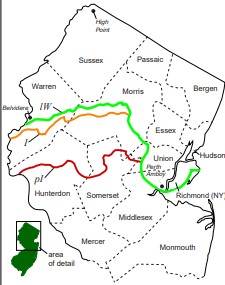
Furthermore, there’s glacial rebound. From roughly 25,000 to 18,000 years ago, a glacier went as far south as present-day Raritan River in North Jersey. The glacier is long gone, however the land is still shifting around from that glacier retreat. That’s also elevating sea levels.
The opposite is true for the northern Jersey Shore beaches. From Sandy Hook to Ship Bottom, tidal flooding was lower than average. Regardless, coastal flooding still brought its fair share of impacts to some of Monmouth and Ocean counties’ most vulnerable spots.
Year-to-year fluctuations in the number of coastal flooding events are to be expected at specific shore locations. Yet, looking at the Jersey Shore as a whole, one cannot deny the upward trend in coastal flooding events, and the reasons behind them.
As for this year, there has been no tidal flooding yet. Let’s hope it stays that way for a while.
Leave a Reply