
Follow Tidal Flooding Talk wherever you get your podcasts at www.tidalfloodingtalk.riverside.com.
When coastal communities think about flooding, attention naturally turns to tides, storm surge, sea-level rise, and the next nor’easter or hurricane. But another process unfolding offshore deserves a place in the coastal conversation: marine heat waves.
Marine heat waves occur when ocean temperatures remain unusually warm for an extended period. Oceanographer Mari Bif, an associate professor at the University of Miami’s Rosenstiel School of Marine, Atmospheric, and Earth Science, explained on Tidal Flooding Talk that these events can persist for weeks, months, or even years. Unlike land, the ocean warms and cools slowly, meaning a relatively small temperature anomaly can represent a substantial amount of stored heat.
That persistence matters.
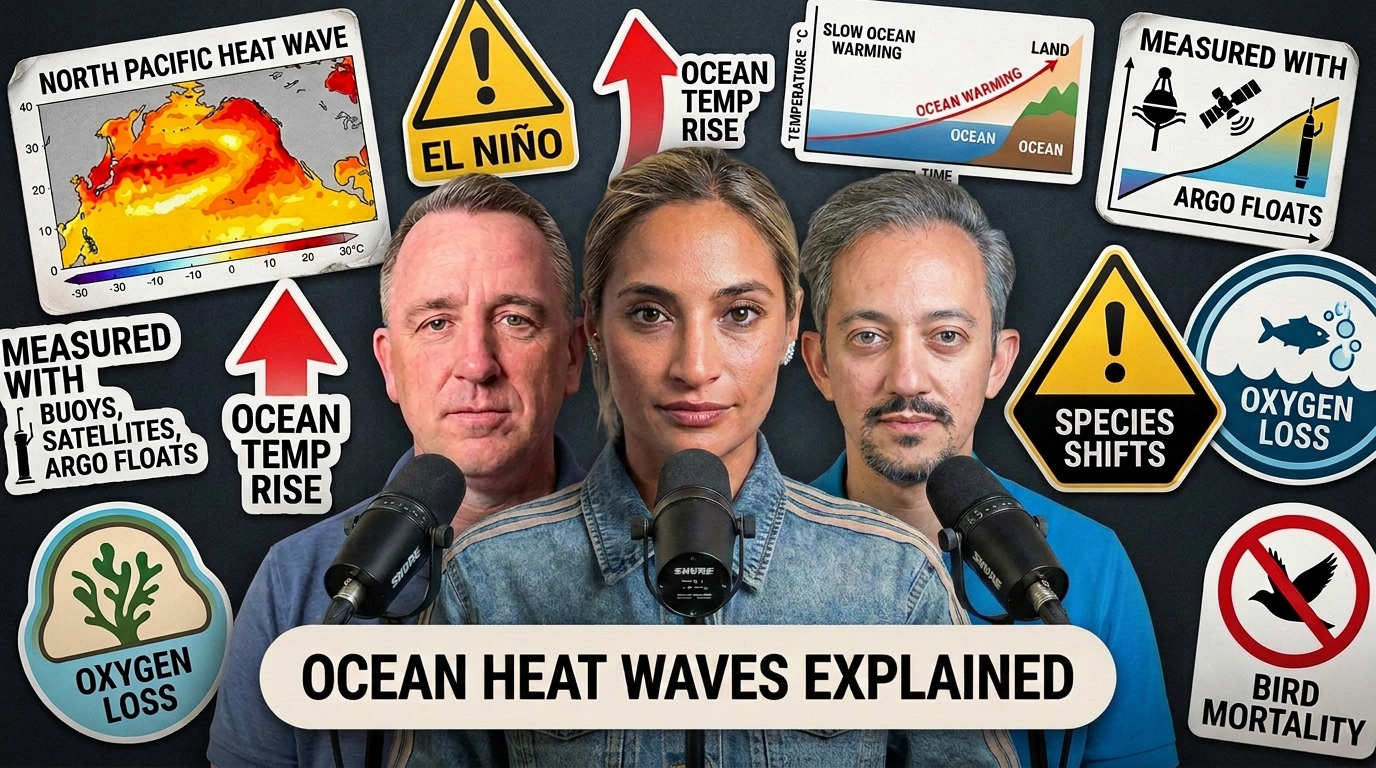
One of the best-known examples was the North Pacific “Blob,” which lasted from roughly 2013 to 2015. According to Bif, that event disrupted marine ecosystems, contributed to harmful algal blooms, shifted fisheries, reduced ocean oxygen, and was associated with widespread seabird mortality. A second major event followed from 2019 to 2020. These impacts demonstrate that unusually warm water is not simply an interesting temperature statistic—it can reorganize coastal and marine systems.
Scientists are getting much better at observing these changes. Ocean monitoring now combines fixed moorings, satellites, and autonomous Argo floats that drift through the ocean while collecting temperature, salinity, and other measurements. Some floats profile water to depths of 2,000 meters, with newer systems reaching approximately 4,000 meters. Biogeochemical floats can also measure properties such as nutrients, particles, pH, and indicators of phytoplankton activity.
For coastal flood practitioners, the important lesson is that coastal risk does not begin at the shoreline.
The relationship between a particular marine heat wave and tidal flooding is not necessarily direct. Bif cautioned against drawing a simple line between a warm patch of ocean and increased coastal flooding or sea-level rise. Yet the broader ocean-atmosphere system is deeply connected. Marine heat waves can interact with large-scale climate patterns such as El Niño, while ocean temperatures influence ecosystems, atmospheric conditions, and the overall climate system.
That makes marine heat waves another reason coastal resilience needs to be multidisciplinary.
Tide gauges and flood maps remain essential, but understanding future coastal conditions also requires looking offshore, downward through the water column, and across entire ocean basins. The better we understand how heat moves through the ocean—and how the ocean responds—the better prepared coastal communities can be for the changing conditions arriving at their doorstep.
Experience Tidal Flooding Talk every Tuesday night, America’s leading show on coastal flooding resilience. Hosted by the New Jersey Coastal Coalition, which formed after Superstorm Sandy in 2012, it empowers leaders with dynamic workshops. Visit njcoastalcoalition.com to learn more!